
Budongo Forest: Location, Map, Animals, and All Facts
The Budongo Forest Guide For First-Time Visitors
Budongo Forest Reserve: location, maps, wildlife (chimpanzees, birds), conservation facts, visitor tips, permits, and research info for travelers and scientists. Budongo Forest sits at the crossroads of cutting-edge primatology and responsible adventure travel. For researchers, it’s a living laboratory: long-term studies from the local research hub, Budongo Conservation Field Station, have tracked social networks, tool use, and diet across habituated chimp communities for decades, producing datasets ideal for comparative behavior, disease ecology, and conservation science. The reserve’s mosaic of semi-deciduous forest, mahogany giants, and riparian corridors supports abundant birdlife and multiple primate species, giving visiting teams reliable study subjects and collaborators among local conservationists and communities in Uganda.
For curious travelers from the US, Europe, and Asia, the reserve offers low-impact trekking, photo-focused walks, and comfortable eco-lodge options that pair easily with wider safaris. Trails are well maintained around habituated groups, local guides combine safety with deep natural history knowledge, and day trips can be combined with visits to nearby highlights such as Murchison Falls National Park for a diverse itinerary of forest, river, and savannah. Whether you’re after quiet observation, birding checklists, or a short research-oriented placement, the reserve’s mix of access and authenticity makes it a practical, inspiring destination.
Budongo Forest Location
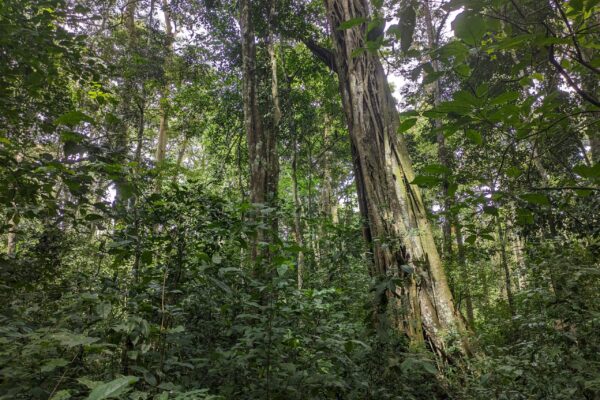
The Budongo Forest is in northwestern Uganda on the edge of the Albertine Rift, roughly three to four hours’ drive northwest of Kampala and bordering Murchison Falls National Park. It spans parts of the Masindi and Hoima districts and includes moist semi-deciduous forest, woodland, and savanna, forming an important catchment for streams that drain into Lake Albert. The reserve lies between about 1°37′–2°03′N and 31°22′–31°46′E, and villages and farmland fringe its margins, creating ongoing conservation pressures that make local engagement essential.
Budongo Forest Map
On detailed regional and topographic maps, Budongo Forest is clearly outlined between coordinates 1°37′–2°03′N and 31°22′–31°46′E; satellite views show dense canopy patches interrupted by agricultural mosaics at the forest edge. Maps identify six administrative blocks (for example, Sonso, Siba, Waibira, Busaju, Kaniyo-Pabidi, and Nyakafunjo) and mark trail networks used for research and chimp tracking. Road links from Masindi and Hoima to main entry points are shown, and conservation agencies and tour operators commonly provide GPS coordinates and downloadable maps for planning and safety.
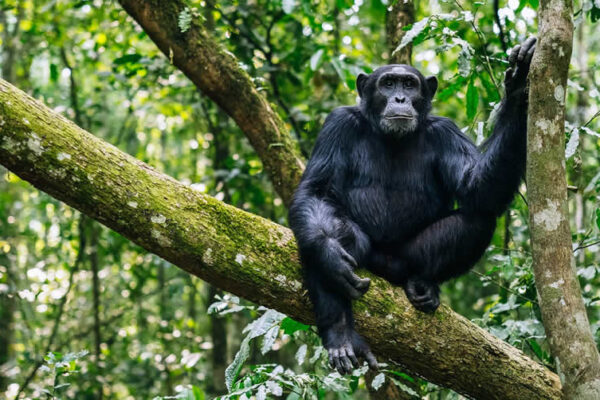
Animals: Budongo is famed for its chimpanzees, with published estimates often cited around 600–800 individuals, including habituated communities used for research and trekking. The reserve hosts at least nine primate species (red-tailed monkeys, olive baboons, black-and-white colobus among them) plus mammals such as buffalo, duikers, and forest pigs. Birdlife is exceptional (over 360 species recorded), while butterflies and moths contribute rich insect diversity. Long-term research from the Budongo Conservation Field Station has revealed complex chimp behaviour, and revenue from eco-tourism helps fund anti-poaching and community programs.
All Budongo Forest Facts
Budongo Central Forest Reserve covers roughly 82,530 hectares (~825 km²) and is classed as a moist, semi-deciduous, medium-altitude forest notable for giant East African mahogany trees reaching impressive heights. It is managed by Uganda’s National Forestry Authority and comprises several management blocks that act as a crucial watershed feeding Lake Albert. Annual rainfall ranges roughly from 1,200 to 2,200 mm with two rainy seasons. Major threats include illegal logging, charcoal production, agricultural encroachment, and poaching; conservation responses include research stations, reforestation projects, community forestry, and regulated chimpanzee-tracking permits to support protection and local livelihoods.
Best/worst time to visit (100 words): The best months for fieldwork and trekking are the drier windows, December to February and June to August, when trails firm up, chimp movement is easier to follow, and access from Masindi or nearby parks is more reliable. Shoulder months can still yield excellent sightings and fewer visitors, but the worst time is the long rains (March–May) and the heavier short rains (October–November), when roads become muddy, forest trails are slippery, visibility drops, and research logistics or permit transfers face more delays. Plan gear for sudden showers year-round and coordinate with guides for the smoothest schedule.