Kilimanjaro Airport (JRO) Facts, Photos, and Duty-Free Shops
All You Need To Know About Kilimanjaro Airport
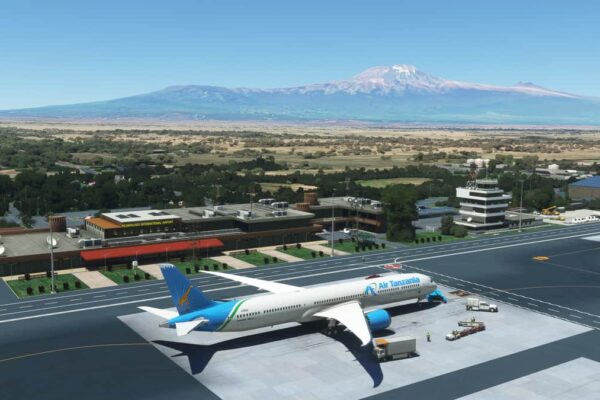
Kilimanjaro International Airport (JRO) is, for most JimJam Safaris travelers, the true starting point of a northern Tanzania adventure. Sitting on the plain between Arusha and Moshi, roughly 45 kilometers from Arusha and 40 kilometers from Moshi, JRO is Tanzania’s second-busiest airport and the primary gateway for the Serengeti, Ngorongoro Crater, Tarangire, Lake Manyara, and Kilimanjaro itself. The airport opened in December 1971, built with an Italian government loan to mark a decade of Tanzanian independence, and in 1998 became the first international airport on the continent to be privatized; today it’s run by the Kilimanjaro Airports Development Company on behalf of the Tanzanian government. Unlike Dar es Salaam’s multi-terminal setup, JRO operates from a single, modern terminal handling both international and domestic flights, with a functional design featuring a distinct triangular roof echoing Mount Kilimanjaro’s shape. It’s genuinely compact; arrivals and departures share a straightforward flow, with short walking distances between the aircraft, terminal doors, and parking area, which makes it a refreshingly low-stress entry point compared to larger East African hubs.
What makes JRO special for our clients isn’t its size but its location: few airports anywhere open onto so much within such a short drive, with Kilimanjaro’s trailheads, the Serengeti, and Ngorongoro Crater all reachable within a few hours. Immigration here is generally faster than at Dar es Salaam, typically taking 15 to 30 minutes, thanks to lower passenger volumes, and on a clear day travelers can often spot Kilimanjaro itself from the terminal or during final approach; visibility tends to be best in the early morning before cloud builds, particularly between June and February. There’s no public transport link into Arusha or Moshi, so pre-arranged transfers matter here more than at most airports; the vast majority of arriving tourists rely on their tour operator to handle this, and this is exactly the kind of detail JimJam Safaris takes care of as standard, meeting travelers on arrival and moving them straight into their safari or Kilimanjaro trek without the friction of negotiating taxis on unfamiliar ground. Ready to fly into JRO and start your northern Tanzania safari the right way? JimJam Safaris can arrange your airport transfer, accommodation, and full itinerary around your flight schedule.
Explore Kilimanjaro Airport (JRO): Facts, location, photos, duty-free shops, airlines, and travel tips for Tanzania’s gateway to Mount Kilimanjaro and the rest of TZ
Kilimanjaro Airport is the main airport for travelers visiting the Northern Safari Circuit, including Serengeti National Park, Ngorongoro Crater, Tarangire National Park, and Mount Kilimanjaro.
Planning your flight into JRO? JimJam Safaris can arrange your airport transfer and build your full northern Tanzania itinerary- Kilimanjaro, Serengeti, Ngorongoro, and beyond—around your arrival.
Kilimanjaro Airport Facts
Kilimanjaro International Airport (IATA: JRO, ICAO: HTKJ) opened on 2 December 1971, built with an Italian government loan to mark a decade of Tanzanian independence. In 1998, it became the first international airport on the continent to be privatized, and it’s run today by the Kilimanjaro Airports Development Company on behalf of the Tanzanian government. It’s Tanzania’s second or third busiest airport depending on the measure used, moving just over a million passengers in 2024. A single passenger terminal handles both domestic and international flights, fed by one 3,600-meter runway capable of taking wide-body aircraft as large as a Boeing 747. Airlines serving JRO include Ethiopian Airlines, KLM, Turkish Airlines, Qatar Airways, and Kenya Airways.
Kilimanjaro Airport Location
JRO sits in Hai District, Kilimanjaro Region, on the plain between the towns of Arusha and Moshi in northern Tanzania. It’s roughly 45–46 kilometers from Arusha and about 40 kilometers from Moshi, positioning it almost exactly halfway between the two main gateway towns to Mount Kilimanjaro and the northern safari circuit. The mountain itself is around 30 kilometers away, and on clear mornings, typically June through February, which offer the best visibility, Kilimanjaro is visible right from the terminal or during the final approach. There’s no public transport connecting the airport to either town, so travelers generally rely on pre-arranged transfers through their tour operator, hotel, or climbing company, which is the standard and recommended approach.
Kilimanjaro Airport Photos
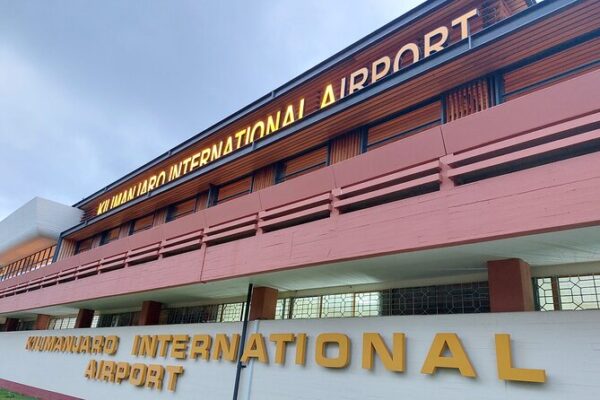
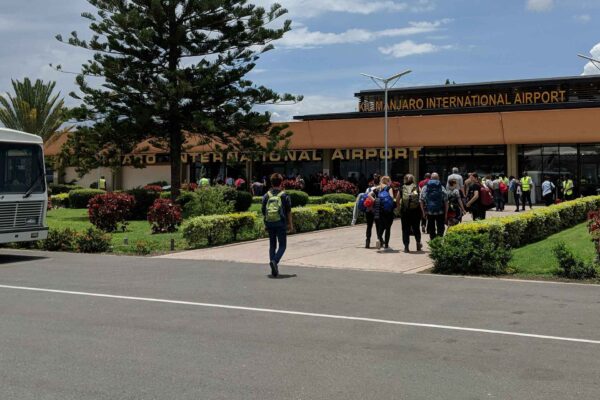
Here’s a look at the terminal and its surroundings.
The main passenger building is low-rise, compact, and easy to navigate, with a distinctive triangular roofline said to echo the shape of Mount Kilimanjaro itself. Arrivals and departures share the same straightforward flow: aircraft, arrivals hall, immigration, baggage claim, and transfers, with short walking distances throughout. The setting itself is part of the experience: landscaped approaches and open plains give way, on clear days, to sweeping views of Kilimanjaro’s snow-capped summit rising in the distance. It’s a modest, functional facility rather than a sprawling international hub, which many travelers find refreshing after long-haul flights, a calmer, more manageable first impression of Tanzania.
Kilimanjaro Airport Duty-Free Shops
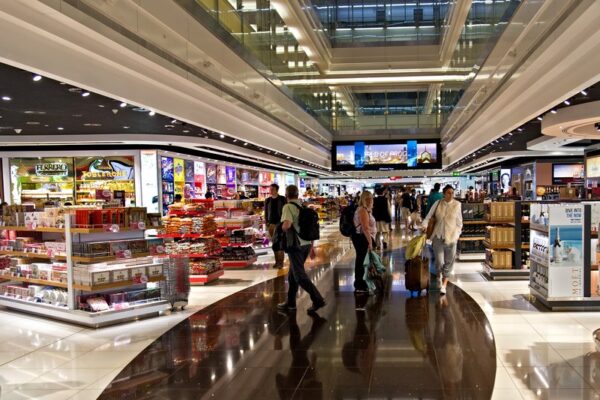
JRO’s single terminal includes duty-free shopping alongside a small selection of restaurants, cafés, banking services, and tour operator desks. Typical duty-free offerings include spirits, tobacco, cosmetics, and Tanzanian specialties like coffee, tea, and local crafts, giving departing travelers a last chance to pick up souvenirs or gifts. Given the airport’s compact size, the retail footprint is modest compared to major international hubs- practical rather than extensive, covering the essentials without extensive browsing options. Immigration at JRO tends to move faster than at Dar es Salaam, generally 15 to 30 minutes, so travelers with connecting flights or transfers shouldn’t expect long waits before or after visiting the duty-free area. Allowances vary by destination country, so it’s worth confirming limits in advance.