
A Perfect 8-Day Rwenzori Trekking Safari For First Timers
The Best Eight-Day Trek to Margherita Peak Via Kilembe Trail
A Perfect 8-Day Rwenzori Trekking Safari for All First-Time Visitors. Experience The Best Eight-Day Rwenzori Trekking Safari to Margherita Peak Via Kilembe Trail Route.
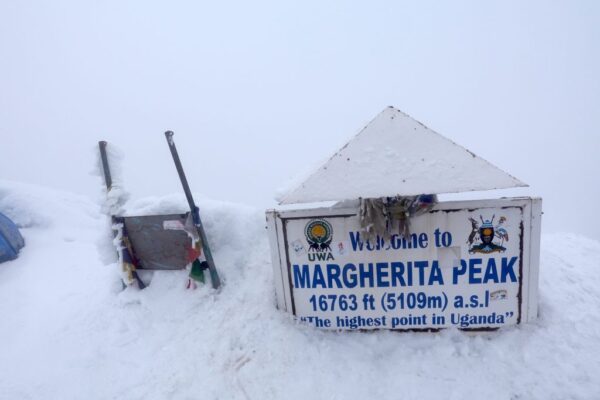
Margherita Peak is Africa’s third-highest peak, but the true beauty is in the Kilembe route’s forests and valleys, where a variety of trees and ferns may be found. Numerous bird and ape species inhabit the trees, and as you ascend the trail, you’ll come across chimp nests perched high in the towering trees. If you’re fortunate, you might catch a glimpse of the resident chimpanzee as they scamper away. Except for a few challenging moves and when it snows, climbing Magherita Peak is more of a scramble than a climb. Nevertheless, the rewards and thrill of reaching the summit are immense as you look across Albert Peak to the DRC (Congo) and then east across the spectra of the Rwenzori Mountains. We supply all the equipment needed for the climb, including carabiners, ropes, and harnesses. You will also need to bring rain gear, warm clothes, hiking boots, and a comfortable sleeping bag. For those in need, we do rent sleeping bags.
Detailed Itinerary: 8-Day Rwenzori Trekking Safari
Day 1: Trek from Trekkers to Sine Hut and Kalalama Camp Lookout
Start the trek at Trekkers (1,450 m) and spend the night at Sine Hut (2,596 m), a total ascent of 1,146 m. More experienced walkers who feel fit can press on to Kalalama Camp (3,134 m) for even better panoramas and extra time at Mutinda Camp, from which you can make the climb to Mutinda Lookout (3,975 m).
The trail climbs steadily from the valley floor through tall trees of the Afro-montane forest. Expect abundant birdlife and the chance to see blue monkeys darting through the canopy; groups of 15–20 black-and-white colobus are sometimes spotted swinging overhead. L’Hoest monkeys are occasionally seen; they are culturally significant to the Bukonzo and traditionally protected by the Omusinga, and you may hear chimpanzees calling in the distance. The vegetation is diverse, ranging from forest giants to bamboo thickets, low shrubs, flowers, and fungi, with moss- and lichen-draped vines adding to the lush atmosphere. Enock Falls is only a short walk from Sine Hut and makes a perfect photo stop.
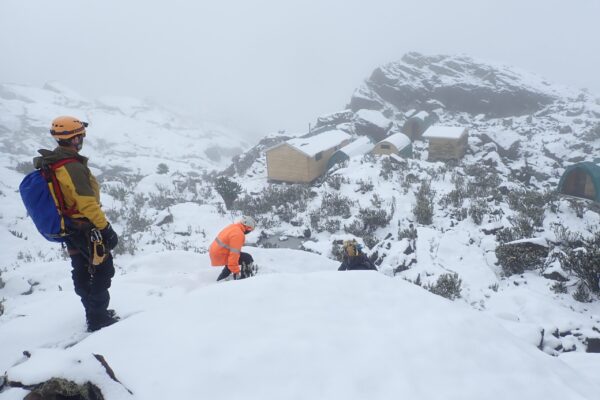
Sine Camp (2,596 m) consists of wooden huts perched on a narrow ridge among tall trees, overlooking a dramatic waterfall. Many visitors enjoy sitting outside by the campfire, talking with guides about the mountains and local life. Located just below the bamboo zone, the area supports a wide variety of bird species; Enock Falls, set in vivid green vegetation and framed by hanging vines, lies only about 150–200 metres from camp. You can choose to sleep at Sine or continue to Kalalama Camp (3,134 m) for broader views and more time to explore Mutinda Camp and its lookout.
Day 2: Rwenzori Day Trek: Kalalama to Mutinda Lookout
Trekking begins at 8:30 am with an immediate ascent through the Bamboo–Mimulopsis Zone. This section is steep with many high steps and, during the rainy season, becomes muddy and slippery, slowing progress. Despite the challenge, the forest scenery is gorgeous as you gain about 551 metres in elevation over 1.8km until reaching Kalalama Camp (3,147m) in the Heather–Rapanea Zone. Here, you can take a short break and enjoy tea or coffee before continuing to Mutinda Camp.
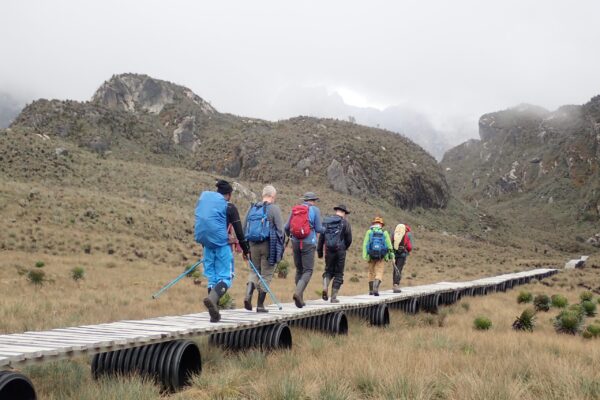
From Kalalama, the trail winds over a series of small knolls along a ridge, then dips into the valley before climbing once more. You’ll cross several small streams and walk near moss-covered waterfalls. The route then follows a mossy river cascading through Giant Heather trees draped in Usnea lichen. The path twists through a deep valley filled with unique plant life and colorful flowers, creating a distinctive mountain setting often veiled in mist.
In the afternoon, hikers can optionally climb to the Mutinda Lookout (1–2 hours up and 1 hour down). The vantage point at 3,925m offers outstanding views over the Rwenzori Mountains, Kasese town, and Lake George. For climbers aiming for Margherita Peak or other high summits, the ascent to Mutinda (3,975m) also provides valuable acclimatization to reduce the risk of altitude sickness.
Overnight at Mutinda Camp (3,582m).
Day 3: Mutinda to Bugata Camp: Valleys, Waterfalls & Peaks
Expect some boggy patches on the way to Bugata Camp, especially after rain, though careful stepping between the tussocks helps a lot. The trail first cuts across the Mutinda Valley through tussock grass and evergreen flowers dotted with towering Giant Lobelias. A sharp climb follows, leading to the Namusangi Valley (3,840m), where waterfalls cascade down cliffs, and the Mutinda Peaks offer brilliant views behind you. The valley widens into a landscape of gentle rises and drops, gradually leading upward to Bugata Camp at 4,100m.
Day 4: Trek to Hunwick’s Camp via Bamwanjarra Pass.
From Bugata Camp, the trail climbs up a ridge, dips briefly, then ascends again to Bamwanjarra Pass at 4,450 meters. A small shelter stands at the pass in case of bad weather. On a clear day, the pass offers outstanding views of the three main peaks. From here, the trail descends through a valley skirting bogs and lush evergreen vegetation thick with moss, giant groundsel, and lobelia. This area is also regarded as one of the best spots in the Rwenzori to see Malachite Sunbirds feeding on lobelia flowers, and it’s a known breeding habitat. Beyond this section, the route becomes steeper before easing into a steady climb over a ridge to Hunwick’s Camp, perched above a deep valley with striking views of Mt Stanley, Mt Baker, Weismann’s Peak, and McConnell’s Prong.
Day 5: Trek from Lake Kitendara to Historic Margherita Camp
Leaving Hunwick’s, the trail drops across the valley to the striking Lake Kitendara, known for its deep waters and lush vegetation. The route then ascends Scott Elliott’s Pass before continuing up the ridge to Margherita Camp at 4,485m, tucked among massive boulders that shield it from fierce winds. This historic campsite was once used by the Duke of Abruzzi during his 1906 ascent of Margherita Peak.
Please take note:
If you feel fit, you can choose to climb Mount Baker today. Baker is a short but challenging climb that is well worth the effort, especially on a clear day when you can see the Glaciers, Margherita Peak, and Mount Stanley.
Day 6: Early Summit Strategy for Mt Stanley Climbers
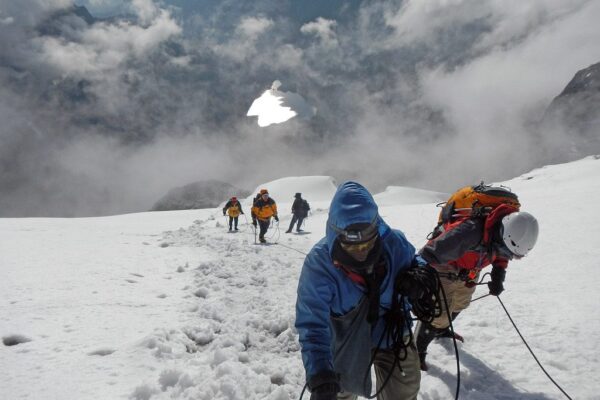
Climbers wake at 2:00 am for an early breakfast before beginning the ascent of Mt Stanley at 2:30 am. This timing has become essential as weather patterns have shifted significantly; even in the traditionally dry season, heavy clouds and snowfall can roll in between 1:00 pm and 4:00 pm within just 10–15 minutes, driven by cloud build-up from the vast Congo rainforests. In January and February 2017, several climbers were forced to halt during severe snow conditions and only returned to Margherita Camp after dark, with one group arriving at 11:00 pm completely exhausted.
Due to these changing weather conditions, a strict turnaround time of 10:00 am is enforced. If the summit is not reached by then, climbers must return for safety reasons, despite any disappointment. Global warming has also affected the Margherita Glacier, with its edges receding and the ice becoming steeper; one section now averages over a 60% incline for approximately 200 meters. In addition, internal melting has created hollow pockets beneath the ice that can collapse. Climbers are therefore expected to follow the guide’s instructions carefully regarding the safest passage.
Those with limited mountaineering experience are encouraged to remain on the Stanley Glacier and ascend instead to a scenic viewpoint on a rocky outcrop near the southern side of Alexandra Peak. From here, stunning views stretch across the Congo and the surrounding lower ridges. After reaching the summit at 5,109 meters, climbers descend directly to Hunwick’s Camp at 3,874 meters.
Day 7: Trek from Hunwick’s Camp to Kiharo Camp via Oliver’s Pass
Distance to Kiharo Camp: 11km
Estimated hiking time: 4–7 hours
From Hunwick’s Camp, the trail ascends a ridge toward McConnell’s Prong, offering panoramic views of the three main peaks and Scott Elliott’s Pass before reaching Oliver’s Pass at 4,505m. The climb from Hunwick’s Camp to the top of Oliver’s Pass covers 3km. The route then traverses beneath Weismann’s Peak toward the confluence of the Nyamwamba River, which descends through Kilembe and Kasese into Lake George in Queen Elizabeth National Park.
Hikers who wish to summit Weismann’s Peak (4,620m) from Oliver’s Pass can do so at an additional cost of USD 20 per person. On clear days, the viewpoint reveals impressive sights of Margherita and Mount Stanley, as well as Mount Speke and Mount Baker.
Beyond the confluence, the trail winds down the valley to Kiharo Camp, nestled in a deep gorge with cliffs and dense vegetation. Along the descent, hikers cross several glacial deposits, ridges of rock and soil pushed forward by ancient, slow-moving glaciers that later melted, leaving behind striking piles of debris marking their former reach.
Day 8: Kiharo to Park Gate: Scenic Descent Through Nyamwamba Valley
From Kiharo Camp, it’s roughly 16 km to the park gate and another 2.8 km to the Trekkers Hostel. The descent typically takes 5–8 hours, so travelers connecting to flights or onward activities should plan to leave Kiharo early.
The descent through the Nyamwamba Valley is mostly downhill and exceptionally scenic, featuring dramatic vistas, moss-covered river rocks, waterfalls, deep valleys, and lush forests that are arguably the finest in the Rwenzori Mountains. It took six years to establish a tourist-friendly route through this section. Notably, in 1937, explorer and geologist McConnell attempted to access the valley but was forced to turn back; today, trekkers can enjoy the route he sought.
A short distance from Kiharo, the trail veers right and follows the river. In the open patches, hikers may spot Duikers feeding quietly. This area is believed to host the densest population of Rwenzori Red Duikers in the National Park. Farther down, the valley steepens, revealing a series of striking waterfalls. Afterward, the trail climbs over a high ridge and descends through thick forest overlooking the valley. Lunch is taken at Forest View Camp before the final walk back to Base Camp, an unforgettable finale to a remarkable trek.
End of Your 8-Day Rwenzori Trekking Safari
8-Day Rwenzori Trekking Safari Cost
The total price for the 8-Day Rwenzori Trekking Safari is $1,755 per person, made up of $1,510 in hiking fees plus $35 per night for national-park entrance fees (7 nights = $245). This rate includes experienced guides, a full team of porters, all meals while on the mountain, mountain accommodation, and the necessary shared equipment for the trek, so your logistical support, camp or hut arrangements, and porterage are covered from the trailhead to camp. Please note that costs such as travel to the start point, personal kit, optional extras, gratuities, or any permits not listed may be additional; check our booking and cancellation terms for full details.
8-Day Rwenzori Trekking Safari Inclusions
- Park Entrances
- All mountain hiking equipment/Gears
- Accommodation and meals
- English-speaking guide
- Ice climbing equipment
- 2 porters per person
8-Day Rwenzori Trekking Safari Exclusions
- Personal expenses
- VISA: You all need a visa to enter Uganda application is done online https://visas.immigration.go.ug
Vaccine: Yellow fever is still required. Make sure you are up to date - A passport, valid for at least 6 months after the entry date, and one full blank page
- Tips and Gratuities
8-Day Rwenzori Trekking Safari Route From Kampala
8-Day Rwenzori Trekking Safari Route From Kigali
Explore Our Rwenzori Trekking Safari Gallery
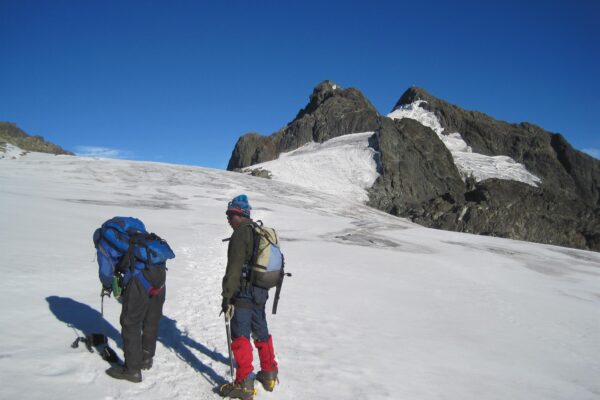
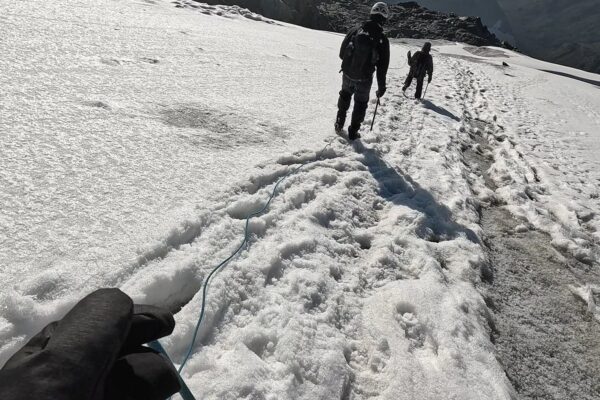
Explore Our Rwenzori Trekking Safari Gallery and discover stunning photos of cloud forests, alpine meadows, and glacier-edged peaks. Each Rwenzori Trekking Safari image captures real trail moments, local guides, wildlife glimpses, and breathtaking viewpoints, so you can picture the route before you go. Flip through the gallery to choose the trek that fits your pace and book your Rwenzori Trekking Safari with confidence.
Travel Advice From JimJam Safaris
JimJam Safaris caters to all ages, budgets, interests, and fitness levels. Our team of experts can assist with queries about the Rwenzori Trekking Safari, Accommodations, bookings, and Affordable Luxury destinations. Our safari experts will respond to your Inquiry as soon as possible. Our team of friendly and service-minded Safari Consultants is available to assist you in making a private, personalized, tailor-made Safari Itinerary and to answer all questions you might have. Are you dreaming of the Wildebeest Migration? Gorilla Trekking in Africa? Honeymoon In Africa: Big Cat Safaris or Africa’s Big 5 Experiences? Start planning affordable luxury Tours with the Affordable Luxury Safari Company (JimJam Safaris & Tours Africa). We tailor-make African Safaris for First Timers, 7-Day African Safari Tours, African Bush Safaris, and Beach Vacations.